Hazard Classification and Identification Report for Transport of Goods

What Is a Hazard Classification and Identification Report for Transport of Goods?
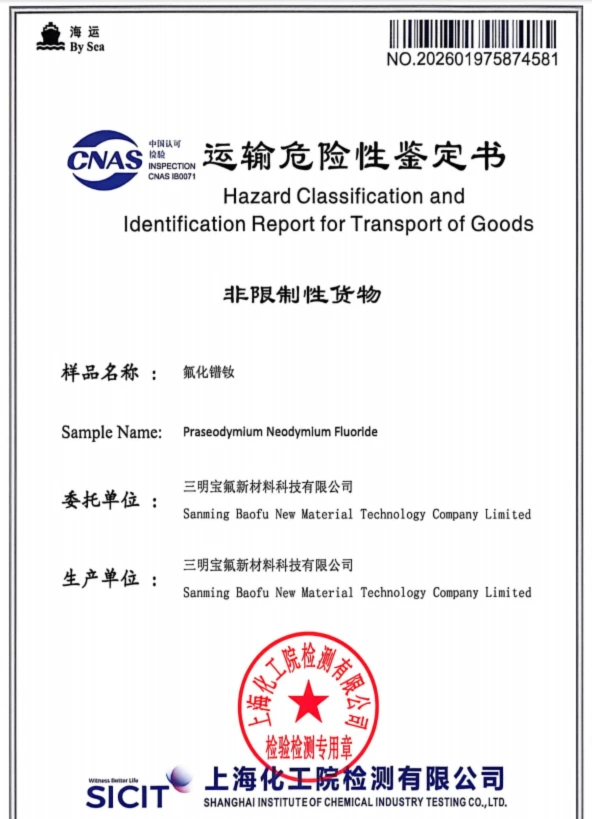
A Hazard Classification and Identification Report for Transport of Goods is a test-based document that assesses whether a product can be shipped safely under stated transport conditions. It is issued by a qualified testing institution rather than by the shipper or carrier.
The report reviews the product and its transport properties. Its conclusion may state that the goods are not restricted for the tested mode. If the product is regulated, the report may identify the UN number, proper shipping name, hazard class or division, and packing group.
The document is common in China export practice for chemicals, powders, liquids, batteries, magnetic products, and other cargo whose transport classification is not clear from the invoice alone. A freight forwarder or carrier may ask for it before confirming space or accepting a booking.
The report is evidence for a specific product and transport mode. A report for sea transport does not automatically cover air transport. If the product, composition, packaging, or applicable rules change, confirm whether the report still applies.
When Is the Report Required?
There is no single worldwide rule that requires this report for every shipment. The requirement depends on the goods, transport mode, carrier, route, and the evidence already available. Carriers often ask for this report when an MSDS does not provide a clear transport conclusion.
| Cargo type | Why a report may be requested |
|---|---|
| Chemicals, powders, and liquids | The carrier needs a transport classification before it can decide whether the goods are dangerous for the booked mode. |
| Lithium batteries and battery-powered goods | Battery details, watt-hour ratings, and packaging affect the applicable UN entry and transport rules. |
| Magnetic products | Air and rail carriers may require evidence that magnetic fields are within the limits for the transport mode. |
| Products claimed to be non-dangerous | The shipper needs more than a product name or invoice description to support that claim. |
The report does not replace shipment-specific documents. If the goods are regulated, the shipper still needs compliant packaging, marking, labels, and a dangerous-goods declaration where one is required. The carrier also makes the final decision on whether to accept the cargo.
Request the report early. Sample testing, document review, and carrier checks can take longer than the booking window, especially for batteries and chemical products.

What the Report Should Cover
The exact format varies by testing institution. Before sending the report to a forwarder or carrier, check that it identifies the product and gives a clear conclusion for the mode being used.
| Report field | What to check |
|---|---|
| Product and shipper details | The report should identify the exact product, model, manufacturer, and shipper or applicant. |
| Composition and sample information | The product composition, physical form, and tested sample should match the goods in the shipment. |
| Transport mode | The report should state whether it covers sea, air, road, rail, or more than one mode. |
| Rules and test basis | It should name the standards, regulations, and edition used for the assessment. |
| Classification conclusion | The conclusion may say the goods are not restricted, or list the UN number, proper shipping name, hazard class, and packing group. |
| Report controls | Check the report number, issue date, testing institution, validity conditions, and any limits on use. |
The report should match the actual shipment. A different model, concentration, battery, or packaging configuration may change the conclusion. Ask the testing institution whether a new test or report is needed when those details change.

Carrier Documents and Review Time
After the report is issued, the shipping line, airline, or other carrier may ask for supporting documents before accepting the booking. The exact list depends on the product, transport mode, and carrier, but it commonly includes:
| Document | Why the carrier may ask for it |
|---|---|
| Hazard classification and identification report | Gives the carrier the tested transport conclusion for the product and mode. |
| MSDS / Safety Data Sheet | Shows the product composition, hazards, handling information, and Section 14 transport details so the carrier can review the shipment. |
| Product and packaging details | Confirm that the report, product specification, and packaging match the cargo being booked. |
Once the carrier has the complete file, review commonly takes about 2–3 business days. Missing pages, inconsistent product details, or additional questions can extend the review, so send the documents together and allow time before the cargo cut-off.
The review period is an estimate, not a carrier guarantee. Some bookings are approved faster, while dangerous goods, batteries, or new routes may take longer.

Carrier-Recognized Testing Institutions
For sea transport, some carriers require a non-dangerous goods appraisal issued by one of their recognized testing institutions. Confirm the current list with the carrier before arranging testing. Acceptance rules and contact details may change.
-
Emergency Management Ministry Chemical Registration Center (NRCC; formerly the State Administration of Work Safety Chemical Registration Center)
No. 339 Songling Road, Laoshan District, Qingdao, Shandong, China. Some carrier lists still show the former address at No. 218 Yan’an 3rd Road.
TEL: 0532-66563300 / 0532-83786584
Website: www.nrcc.com.cn
-
Shanghai Research Institute of Chemical Industry
TEL: 021-52815377 FAX: 021-52505134
Website: www.msds.gov.cn
-
Dalian Dangerous Goods Transport Research Center
TEL: 0411-82629065 / 82626043 / 82622908
FAX: 8262904
-
Industrial Products and Raw Materials Testing Technology Center, Shanghai Entry-Exit Inspection and Quarantine Bureau
Now operated by Shanghai Customs as the Shanghai Customs Industrial Products and Raw Materials Testing Center.
No. 299 Mianbei Road, Pudong New Area, Shanghai, China
TEL: 12360 (Shanghai Customs service hotline)
Website: shanghai.customs.gov.cn
-
Shanghai Institute of Measurement and Testing Technology
No. 1500 Zhangheng Road, Pudong New Area, Shanghai 201203, China
TEL: 021-38839800 FAX: 021-50798390
Website: www.simt.com.cn
-
PONY Testing International Group (PONY)
No. 66 Jindai Road, Zhongguancun Environmental Protection Technology Demonstration Park, Haidian District, Beijing, China
TEL: 400-819-5688
Website: www.ponytest.com
-
SGS-CSTC Standards Technical Services Co., Ltd. (SGS)
TEL: +86 400 099 6058
Website: www.sgsgroup.com.cn
-
Intertek Testing Services (ITS)
TEL: 400 886 9926 Email: service.china@intertek.com
Website: www.intertek.com.cn
-
Bureau Veritas (BV)
TEL: +86 400 920 1828 (commodities and industrial services)
Website: www.bureauveritas.cn
-
TÜV (Technischer Überwachungsverein)
TÜV is a brand shared by several independent groups. Confirm the legal entity recognized by the carrier.
Websites: TÜV Rheinland TÜV SÜD TÜV NORD
-
Underwriters Laboratories Inc. (UL)
UL Solutions Shanghai office: 29F, Units 3 and 4, Wheelock Square, No. 1717 Nanjing West Road, Jing’an District, Shanghai 200040, China
TEL: 021-6137 6300
Website: www.ulsolutions.com.cn
-
CNOOC Tianjin Chemical Research & Design Institute
No. 85 Dingzigu 3rd Road, Hongqiao District, Tianjin 300131, China
TEL: 022-26689275 / 022-26689265 (physical and chemical testing)
Website: www.trici.cn
-
Guangzhou Vkan Certification & Testing Co., Ltd. (CVC)
No. 3 Tiantai 1st Road, Huangpu District, Guangzhou, China
TEL: 020-32293888 Email: office@cvc.org.cn
Website: www.cvc.org.cn
-
Guangzhou MCM Certification & Testing Co., Ltd. (MCM)
TEL: 4008-368-355 / 13622887960 Email: 24h@mcmtek.com
Website: www.mcmtek.com
-
Dangerous Goods Management (China) (DGM)
BGS Cargo Terminal, Room 249, Tianzhu Comprehensive Bonded Zone (New Area), Huoyun North Road, Shunyi District, Beijing, China
TEL: 400 628 8233 / 010-69479673
Website: www.dgmchina.com.cn
-
The Second Research Institute of CAAC (CAACSRI)
No. 17, South Section 2, Second Ring Road, Wuhou District, Chengdu, Sichuan, China
TEL: +86 28 82577336
Website: www.caacsri.com
The carrier makes the final decision on whether it accepts the institution and the report. Check the institution, report scope, and testing requirements with the carrier before arranging the appraisal.
How This Report Differs from Other Documents
Compliance files often contain several related documents. Each one answers a different question.
| Document | What it does | What it does not replace |
|---|---|---|
| Hazard classification and identification report | Records the tested transport conclusion for a product and mode. | Carrier acceptance, shipment packaging, or a dangerous-goods declaration. |
| MSDS / Safety Data Sheet | Explains hazards, safe handling, storage, and emergency response. | A final transport classification or proof that a carrier will accept the cargo. |
| UN38.3 test summary | Shows that a lithium cell or battery type passed the UN38.3 tests. | The full transport classification, packaging instructions, or carrier approval. |
| Dangerous-goods declaration | Declares the shipment details and classification for a regulated movement. | The underlying test report or the shipper’s duty to classify and pack correctly. |
| Carrier approval | Confirms that a specific carrier accepts the cargo and booking conditions. | A test report, safety data sheet, or regulatory declaration. |
Send the current report, Safety Data Sheet, product details, packaging specification, and intended transport mode together. The forwarder can then check that the documents agree before the carrier reviews the booking.
Quote UsCheck the Transport Documents Before Booking
Send us the product name, Safety Data Sheet, hazard classification and identification report, packaging details, and intended route. We will review the documents and coordinate the carrier requirements.
Get a Free QuoteThis is general information only. Transport classification requirements, accepted test standards, report validity, document requests, carrier review time, carrier-recognized institution lists, contact details, and acceptance rules vary by product, mode, route, and country. The 2–3 business day review period is indicative. Confirm the current requirements and timing with the testing institution and carrier before booking.